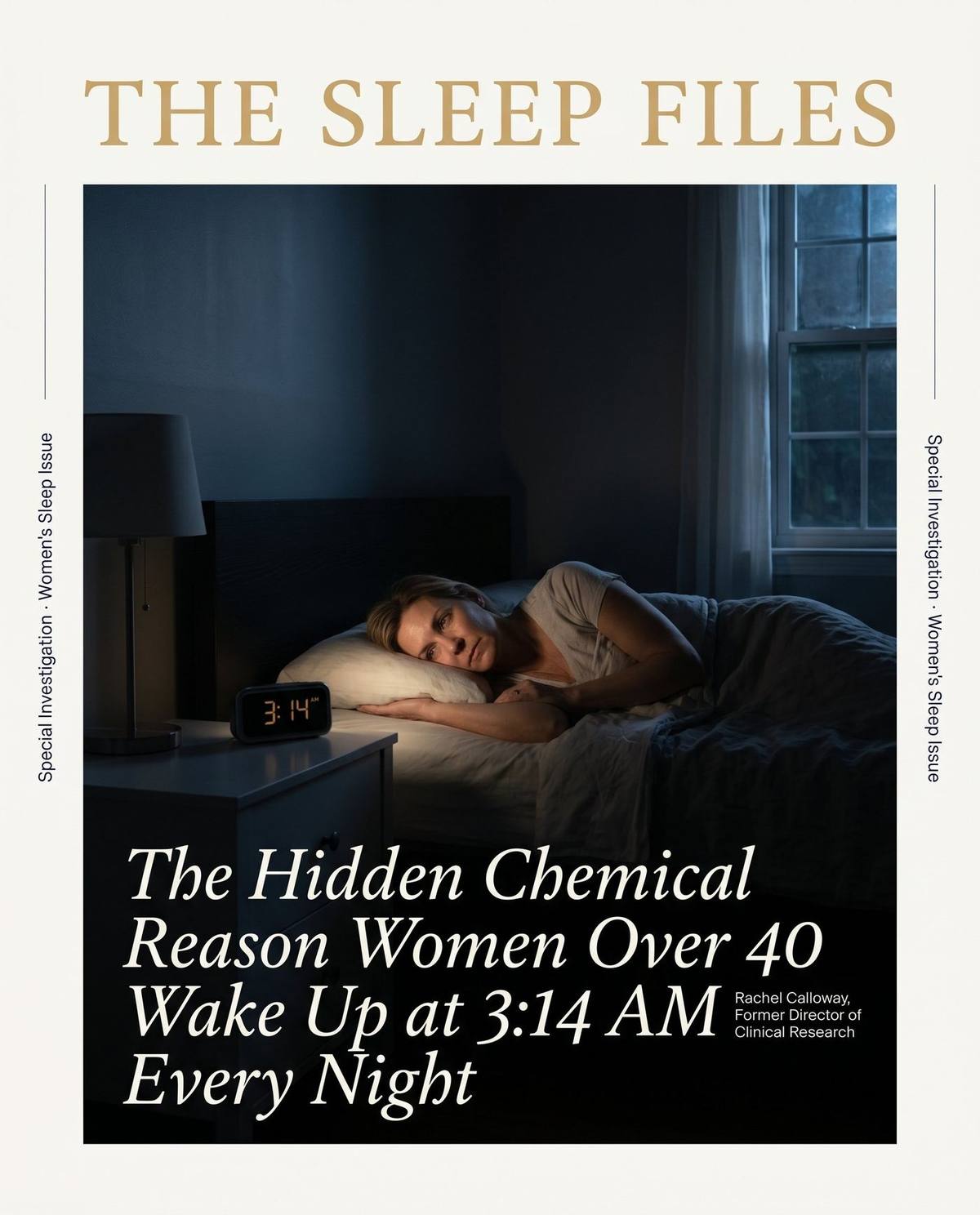
A former drug researcher spent 18 months finding the real answer. Your brain fires a false chemical alarm in the night. And the whole supplement industry sold you the wrong fix.
It's 3:17 AM.
You know because you've been watching those red numbers. Four minutes now.
The room is dark. Your partner is asleep beside you. The house is quiet.
But your heart is pounding. Your mind is already racing. You don't know why.
Your neck feels hot. The sheets feel too tight. You kick one leg out.
You are exhausted. Deep-down, bone-tired exhausted. The kind that has been building for months.
But sleep? Sleep is completely gone.
If you know this feeling — the pounding heart, the wave of panic, lying there wide-awake while your body runs on empty — keep reading.
Because you have almost certainly heard the same thing I heard for two years:
"Your labs are normal. It's probably stress. Have you tried meditation?"
What my doctor never told me — what took me 18 months of research to find — is that what happens in your brain between 2:00 AM and 4:00 AM is not stress. It is not anxiety. It is not a mindset problem.
It is a specific chemical event. One you can't control. One that fires on a schedule.
And until you know what triggers it, nothing will stop it. Not sleep hygiene. Not herbal gummies. Not an expensive cooling mattress pad. Nothing.

3:14 AM. The alarm no one set.
Until four years ago, I ran clinical research at a drug company in Boston. I was a working mom with two teenagers. By most measures, I handled pressure well.
My husband called me "the most functional person I've ever met." My team called me unflappable.
At 47, I started waking up at 3:14 AM.
At first, twice a week. I blamed a brutal work deadline. I cut back on caffeine. I bought a weighted blanket my cat claimed right away.
It got worse.
By month three, I woke up every single night. Heart pounding. Overheated. Mind already at full speed. All within fifteen minutes of 3:00 AM. Like something had set an alarm I never agreed to.
I lay there for one, sometimes two hours. Watching the clock. Counting the sleep I had left. Feeling the dread build.
By month six, my professional edge was going dull fast. I was forgetting words mid-sentence. Making errors I would have caught instantly before. I was snapping at my team in ways that embarrassed me. By 2:00 PM, brain fog hit so hard I couldn't remember what I had just stood up to do.

My doctor ran every test. Thyroid. Blood sugar. Iron. Cortisol. All normal.
"You're entering perimenopause," she said, almost cheerfully. "Completely normal. Try reducing stress and practice good sleep hygiene."
I had spent fifteen years reviewing medical research for a living.
Normal is not a treatment plan.
Over the next eight months, I became a very expensive science experiment on myself.
I slept — technically. But I felt like concrete until 11 AM every morning. I was swapping one problem for another. I stopped.
I tried 1mg, 3mg, and 5mg. The 1mg did nothing. The 3mg had zero effect on the 3:00 AM waking. The 5mg left me impaired every morning. And when I stopped it, the nighttime anxiety got worse. Synthetic melatonin is a blunt override of your body clock. When the override lifts, your nervous system often snaps back harder. I was making the problem worse.
Valerian root. Passionflower. L-theanine. Magnesium gummies. Ashwagandha. A seventy-dollar adaptogen blend. I kept a spreadsheet. I gave each one a real trial. A few helped me feel slightly calmer at bedtime. Not one stopped the 3:00 AM waking.
And here's what infuriated me most. Every single one of these products promised to "balance my hormones" or "restore hormonal harmony." Big claims. Broad promises. Not one explained what was actually happening in my brain at 3:00 AM. Not one was built for that specific problem.
I followed every sleep hygiene protocol I could find — caffeine cutoffs, alcohol elimination, blackout curtains, 67-degree bedroom — with meticulous consistency for three months.
The 3:14 AM wake-up did not care. It didn't care because sleep hygiene addresses the conditions around sleep. None of it touches the cortisol spike. None of it replaces the GABA buffer. It was the right answer to the wrong question.
None of these things were targeting why I was waking up. I was managing the alarm. I was never touching the circuit behind it.
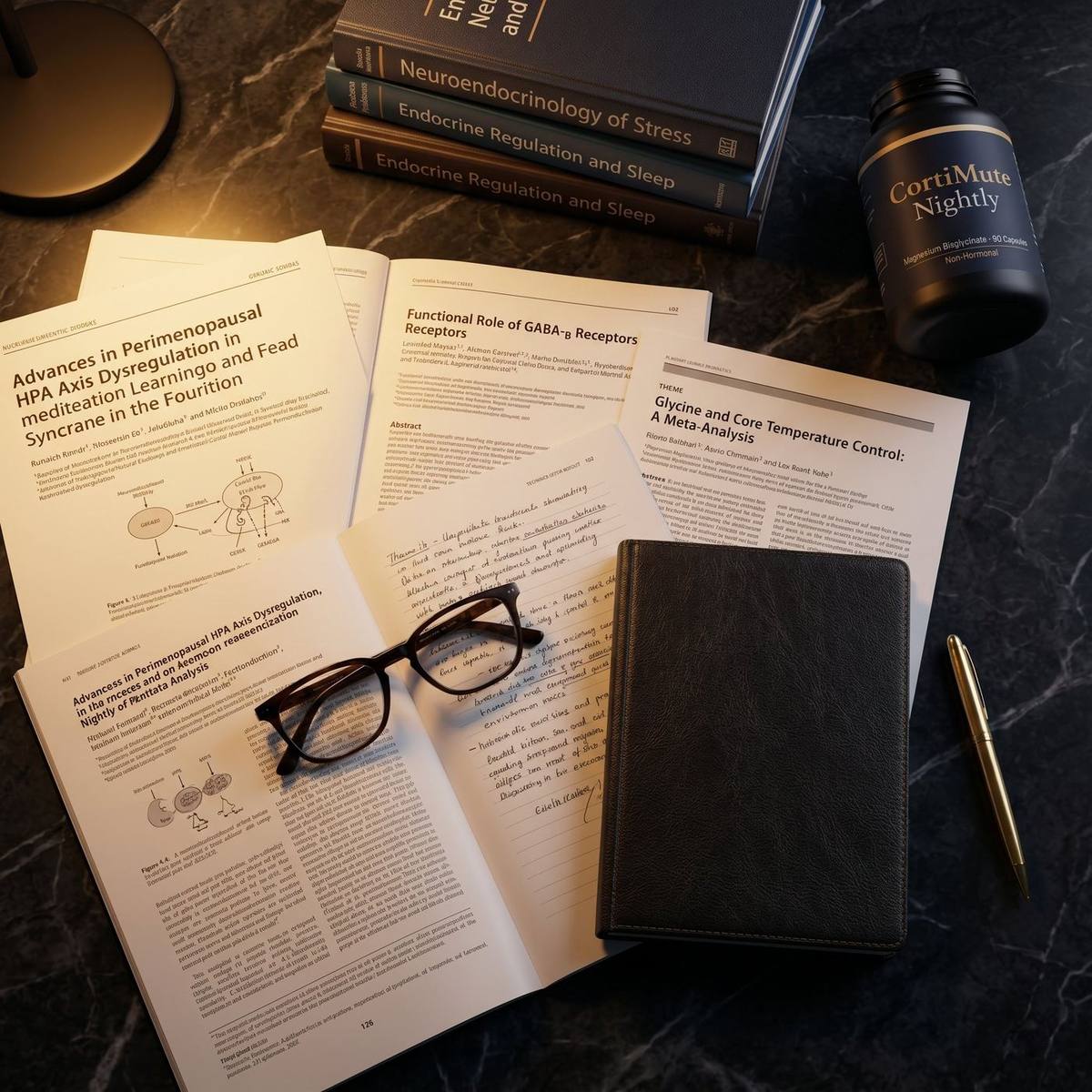
The answer came from an unexpected place.
I was reading neuroendocrinology papers on a different topic. Then I found a study on perimenopausal women who woke up at night. The researchers tracked exactly what was happening in these women's brains at the exact moment of waking.
What they found was not vague.
These women were not waking up because of stress, caffeine, or bad habits. They were waking up because of a precise, predictable chain of events. One that fired on a schedule — no matter how well they managed their lives.
A chemical false alarm. Every single night.
I spent three more months pulling every related paper I could find. On cortisol. On GABA. On sleep and the brain in perimenopause. What I assembled was so clear — and so absent from anything my doctor had told me — that I felt genuinely angry.
Not at my doctor. At a system that decided women's sleep in their forties and fifties wasn't worth explaining properly.
Let me explain it properly.
To understand the false alarm, you need to know two things. A brain chemical you've been quietly losing. And what happens to your stress system when it's gone.
You probably know progesterone as a reproductive hormone. Most doctors stop there.
Here's what they don't explain.
In your brain, progesterone converts into a compound called allopregnanolone. Think of it as your brain's nighttime guard. It binds to your GABA-A receptors — your brain's main "calm down" switches — and keeps them working all night long. Its only job is to stand between your sleeping brain and anything that might disturb it.
Every night for decades, this guard worked in the background. Absorbing stress signals. Dampening your alarm system. Keeping your HPA axis — your body's main threat detector — from overreacting to small, routine nighttime signals.
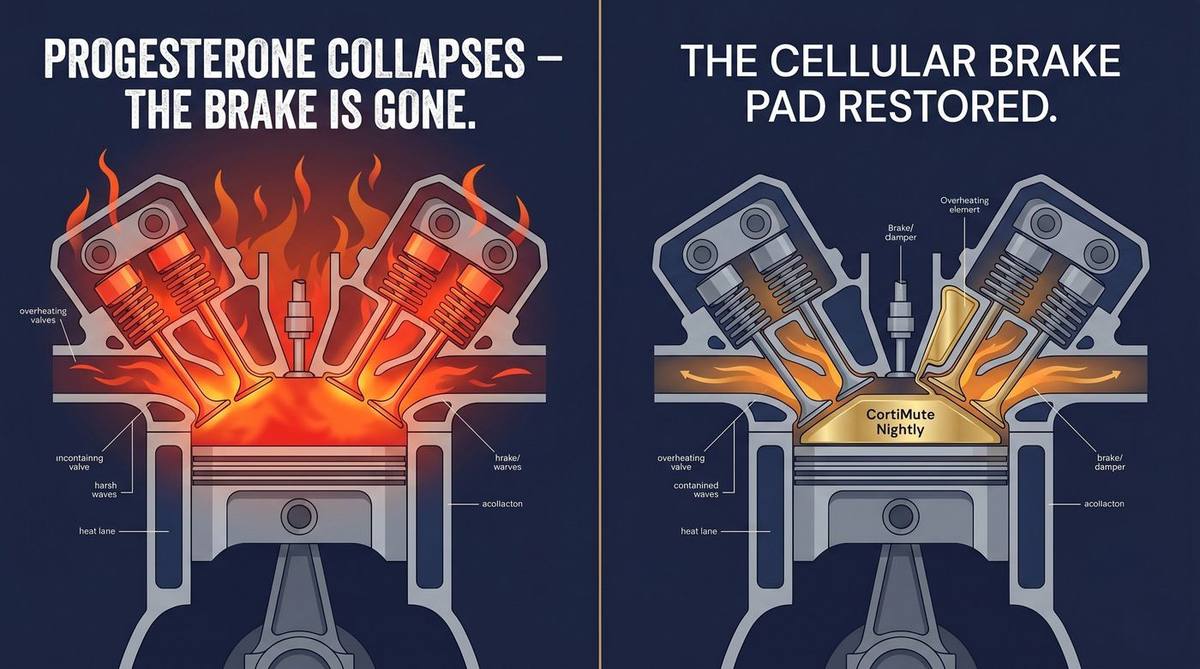
During perimenopause, your progesterone doesn't just drop. It crashes and swings wildly. And every time it drops, your supply of allopregnanolone drops with it.
Your nighttime guard stops showing up. Your brain's brake pad disconnects.
The loss of your GABA guard creates a second, less obvious problem.
GABA and its opposite — an excitatory brain chemical called glutamate — are supposed to stay in balance. GABA keeps your brain calm. Glutamate keeps it alert.
When your GABA buffer collapses, glutamate wins. Unopposed.
This is the exact source of the "tired but wired" state. Your body is completely empty. But your brain is flooded with stimulating signals it cannot turn off. Racing thoughts. Spiraling anxiety. A mind that simply won't slow down.
This is not who you are now. It is a chemical imbalance you did not create.
In every person, cortisol starts a slow, natural rise between 2:00 and 5:00 AM every night. This is the Cortisol Awakening Response. It is healthy and normal. Its job is to gently prepare your body to wake up.
In a healthy premenopausal system, this rise is tiny. Barely a whisper. The nighttime guard absorbs it. You sleep right through.
Now take the guard away.
Without allopregnanolone standing watch, your brain's threat system becomes fragile and reactive. It can no longer tell the difference between a gentle hormonal signal and a real emergency.
So when that 3:00 AM cortisol rise hits — the same wave your body has produced every night of your adult life — your unprotected brain does not feel it as a soft signal.
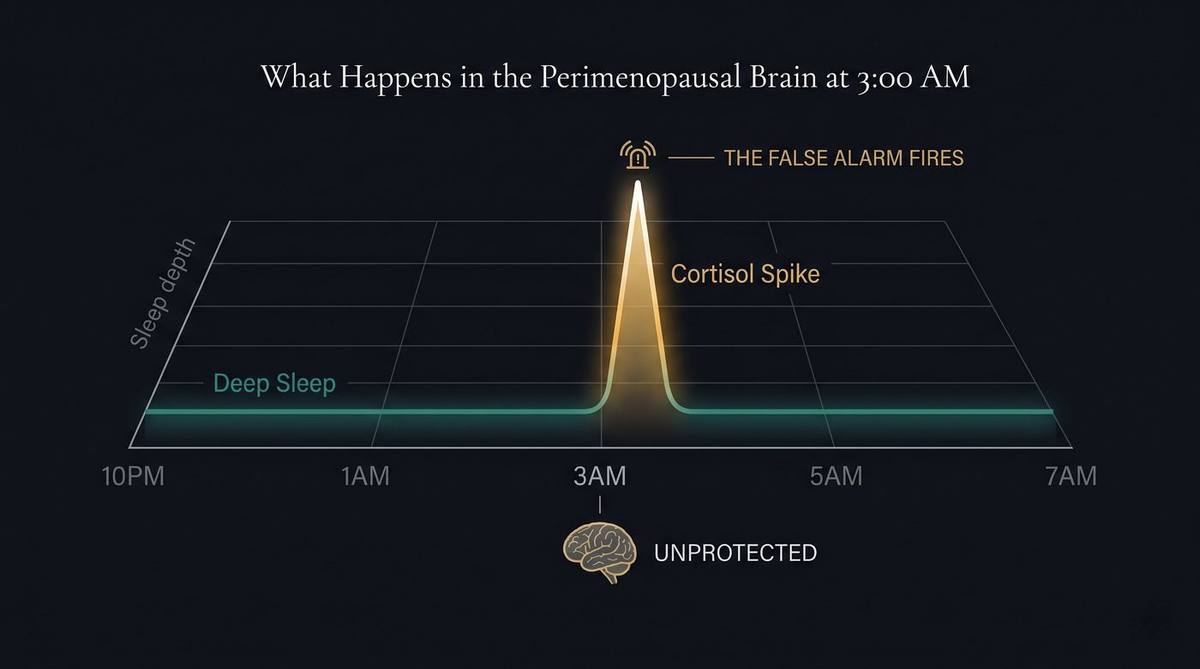
It treats it like a code red.
In seconds, your fight-or-flight system fires. Adrenaline floods your blood. Your heart rate spikes. Your temperature rises. Your brain jolts from deep sleep into full alarm mode — in the middle of the night — for no outside reason at all.
You are awake. Completely. Immediately. Heart pounding. At 3:14 AM.
This is not stress. It is not anxiety. It is not proof you can't cope.
It is your brain responding exactly as it was built to — to a false alarm it no longer has the tools to recognize as false.
There is a second failure happening at the same time.
Your brain has a master clock called the suprachiasmatic nucleus, or SCN. One of its most important jobs is managing your core body temperature during sleep. Your core must drop about 1 to 2 degrees Fahrenheit for your brain to enter deep, slow-wave sleep. Without that drop, deep sleep never fully begins.
During perimenopause, falling estrogen throws off your brain's thermostat. Your sleep temperature window gets much smaller.
This is why you're suddenly overheating in a 67-degree room. This is why you kick the covers off, pull them back, kick them off again. This is why you wake up with a hot neck and no idea why.
And these two failures feed each other. The overheating pushes you into lighter sleep just as the cortisol spike fires. Each one makes the other worse. Until you're bolt upright in the dark, sweating, wired, and completely at a loss.
I want to stop here.
Because I know what many of you are carrying. I carried it for two years.
A quiet, painful belief that this is somehow your fault. That other women manage stress better. That the version of you who slept well and was sharp and confident — she's gone. You did something to lose her.
Maybe you've even wondered: Is this just who I am now? Is this the new normal?
It is not.

What is happening to you at 3:00 AM is not permanent. It is not who you are now. It is not the new normal.
You are a capable, intelligent woman in the prime of your life. You are temporarily derailed by a very specific chain of biological events that your doctor most likely never explained.
Your nighttime guard went offline. Your alarm system started misfiring. Your brain's thermostat broke. And an industry full of "hormone harmony" blends took your money without ever touching the actual problem.
None of that is your fault.
Chemistry problems have chemistry solutions.
Once I understood exactly what was breaking down — the GABA crash, the glutamate flood, the cortisol spike, the thermal failure — I stopped looking for things to help me fall back asleep. I started looking for something that could reach the exact circuit misfiring and disarm it before the alarm ever fires.
What I found next changed everything.

But first — if you've already tried magnesium and it didn't work, or worse, sent you running to the bathroom — I need to tell you about something called the Magnesium Mayhem. There's a very specific reason it failed you. It has nothing to do with whether magnesium works. It has everything to do with which molecule you were sold.
One question first.
When you took magnesium before — from the drugstore, the wellness brand, the "sleep blend" at the health food store — what form was it?
If the label said "Magnesium Oxide," or listed no form at all, I have two things to tell you.
The good news: magnesium can absolutely address the exact failures behind the 3:00 AM hijack. The research on this is clear and well-documented.

The bad news: Magnesium Oxide is a laxative. It has no meaningful effect on your brain at all. And it is what most of the supplement industry has been selling you.
Here is exactly what happens when you swallow a standard Magnesium Oxide capsule. The magnesium doesn't travel to your brain. It doesn't reach your GABA receptors or your stress system. It passes into your colon. There, it acts like a sponge — pulling water out of the surrounding tissue and into the bowel. That is not a side effect. That is the entire mechanism. Magnesium Oxide was a constipation treatment. It was then relabeled, put in a calming-looking bottle, and placed in the sleep supplement aisle.
If you tried magnesium and spent a miserable night or morning in the bathroom — that was not a reaction to magnesium. That was a predictable response to a compound never built to help your nervous system.
Magnesium Citrate is somewhat better absorbed. But it still causes enough gut disruption at neurologically useful doses that women dropped out of clinical trials because of it. They didn't fail magnesium. They were given the wrong molecule.
The failure was the product. Not you.

Deep in the neurology and sleep literature — not the sports recovery world, not general wellness — I kept finding one form of magnesium that behaved completely differently.
Magnesium Bisglycinate.
Bisglycinate is a fully chelated mineral. "Chelated" means the magnesium is not loose. It is chemically locked to two molecules of an amino acid called glycine. This changes everything about how it moves through your body.
Because the magnesium is bound to glycine, it bypasses the gut pathways that turn oxide and citrate into digestive disasters. Instead, it travels through special amino acid channels in your intestinal wall — the same ones your body uses to absorb protein from food. The magnesium arrives in your bloodstream intact. Absorption is much higher. Stomach tolerance is much better.
But that is only the delivery system. Because glycine is not just a carrier.
Glycine is an active, clinically studied sleep compound on its own. It addresses the exact second failure behind the 3:00 AM hijack — the thermal one.
When I mapped out what the perimenopausal brain needed to stop the false alarm, I needed two things at once. Something for the brain failure — the lost GABA buffer, the glutamate flood, the overreacting stress system. And something for the body failure — the broken temperature control, the overheating that makes every other problem worse.
What makes Magnesium Bisglycinate stand apart is that one compound does both. Not through vague general relaxation. Through specific, documented mechanisms in two separate systems.
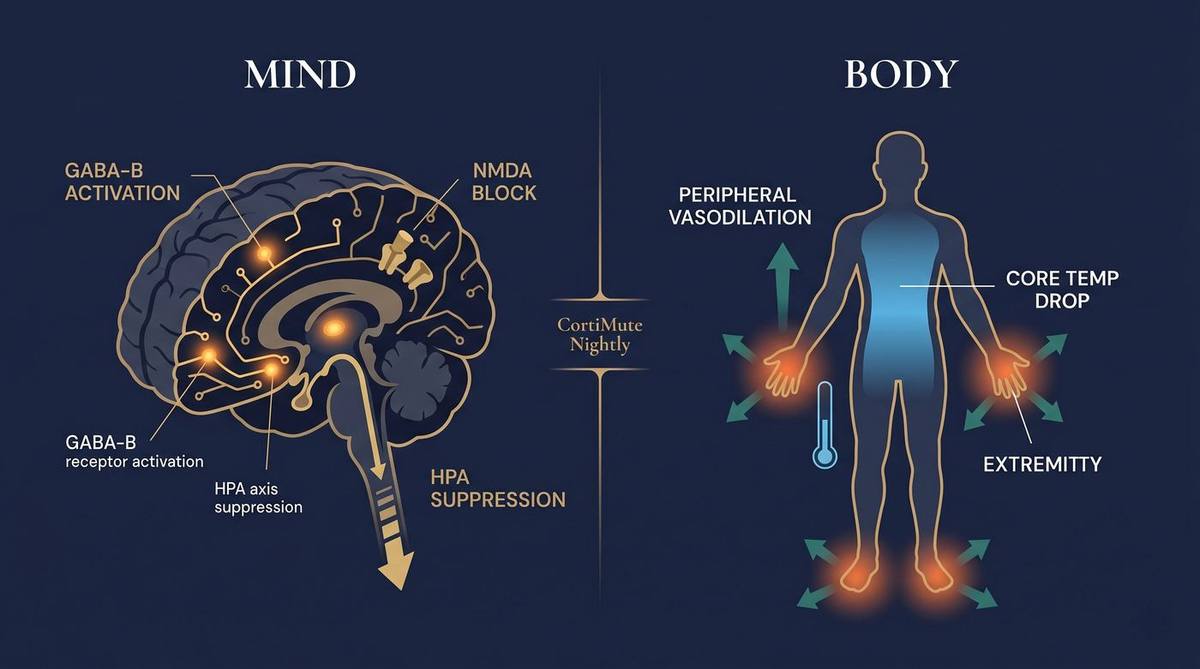
First: it supports GABA-B receptor activity — the same calming pathway that allopregnanolone used to protect. This is not like taking a sedative. A sedative forces your brain offline by overriding its activity entirely. Magnesium works differently: it helps restore your brain's own calming signals, partly replacing the inhibitory buffer that progesterone took with it when it dropped.
Second: it helps support healthy NMDA receptor function. NMDA receptors control how powerfully glutamate fires in the brain. When your GABA buffer is gone and glutamate goes unchecked at 3:00 AM, NMDA overactivity is associated with racing thoughts, spiraling anxiety, and a mind that won't slow even when your body is empty. Magnesium helps support normal activity at that receptor. The excitatory response quiets.
Third: it helps support healthy HPA axis function at night. Magnesium may help promote healthy nighttime cortisol levels. The 3:00 AM cortisol rise doesn't vanish — that would not be healthy — but research suggests its amplitude may be significantly reduced. Instead of a sharp spike your unprotected brain reads as an emergency, it may become closer to the gentle, gradual wave it was always supposed to be.
The false alarm response may be meaningfully reduced at its source.
Research on glycine shows something elegant. When you take it orally, glycine triggers rapid opening of blood vessels in your hands, feet, and skin. Not a general relaxation response. A targeted mechanism that pushes heat from your body's core outward — where it can escape.
The result may be a real drop in core body temperature. About 1 to 2 degrees Fahrenheit. Which is precisely what your brain's master clock needs as a trigger to start and hold deep, slow-wave sleep.
Glycine may support the temperature drop your perimenopausal hypothalamus can no longer reliably create on its own. It works against the overheating and night sweats that have been compounding your cortisol problem every single night.
No synthetic hormones. No sedative override. Two specific mechanisms. Two root causes. One chelated compound.
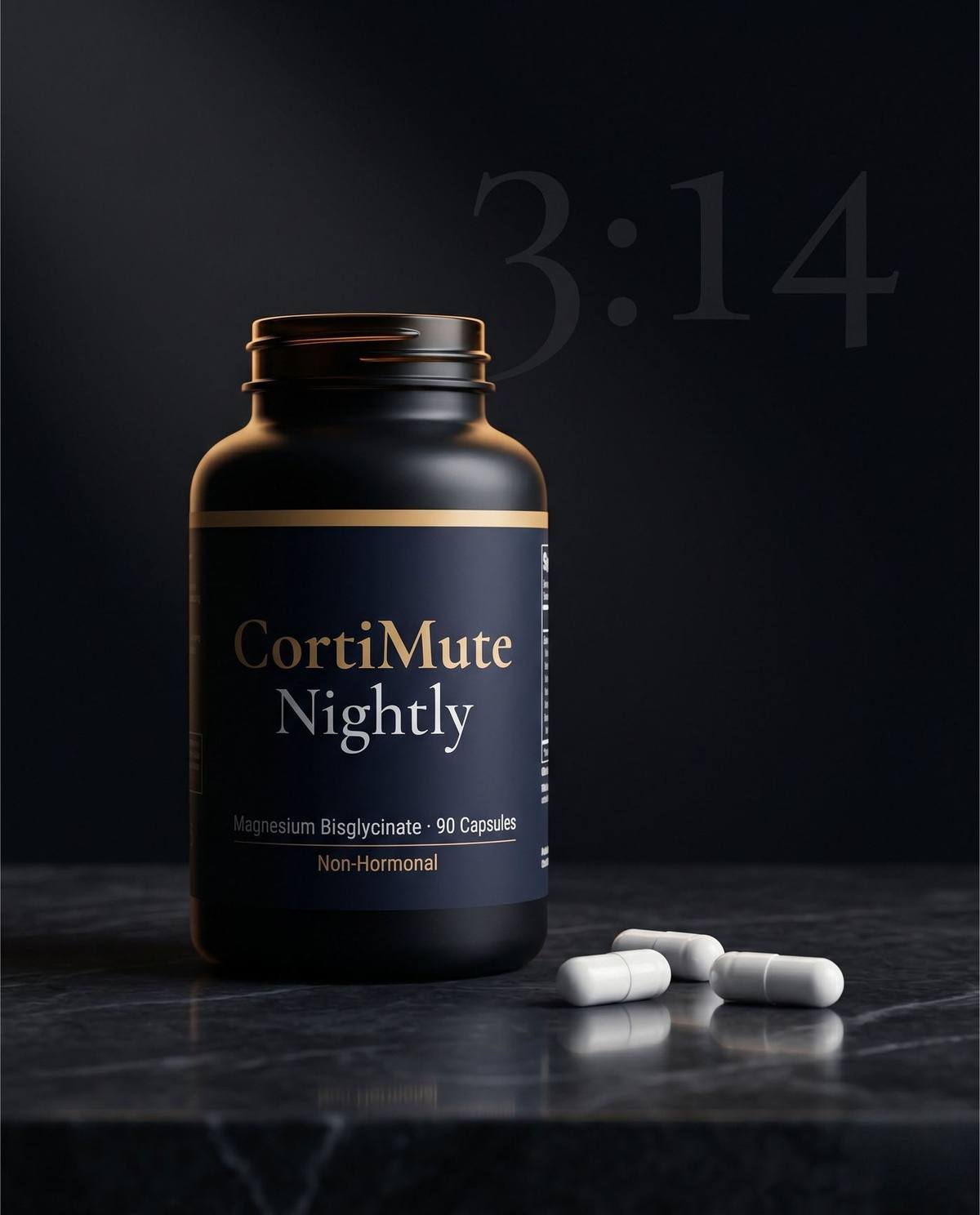
After completing this research, I spent a long time looking for a Magnesium Bisglycinate formula built for the specific neurological needs of perimenopause. Not sports recovery. Not general relaxation. The precise dual-action profile I had mapped out.
I couldn't find one that met the standard. Every bisglycinate formula I evaluated was positioned for general relaxation or muscle recovery — not for the specific neuroendocrine profile of perimenopause. None calibrated the dose for neurological support specifically. None addressed the cortisol-dampening and thermal pathways together in a single compound, with the serving structure to allow dose adjustment around daily stress. So I built it.
Each serving is three easy-to-swallow vegetarian capsules taken in the evening — the Modular Titration System. On high-stress days, take one capsule with dinner to start calming your stress system early, then two more about thirty to sixty minutes before bed. On calmer days, take all three at bedtime. Your needs shift. Your formula should too.
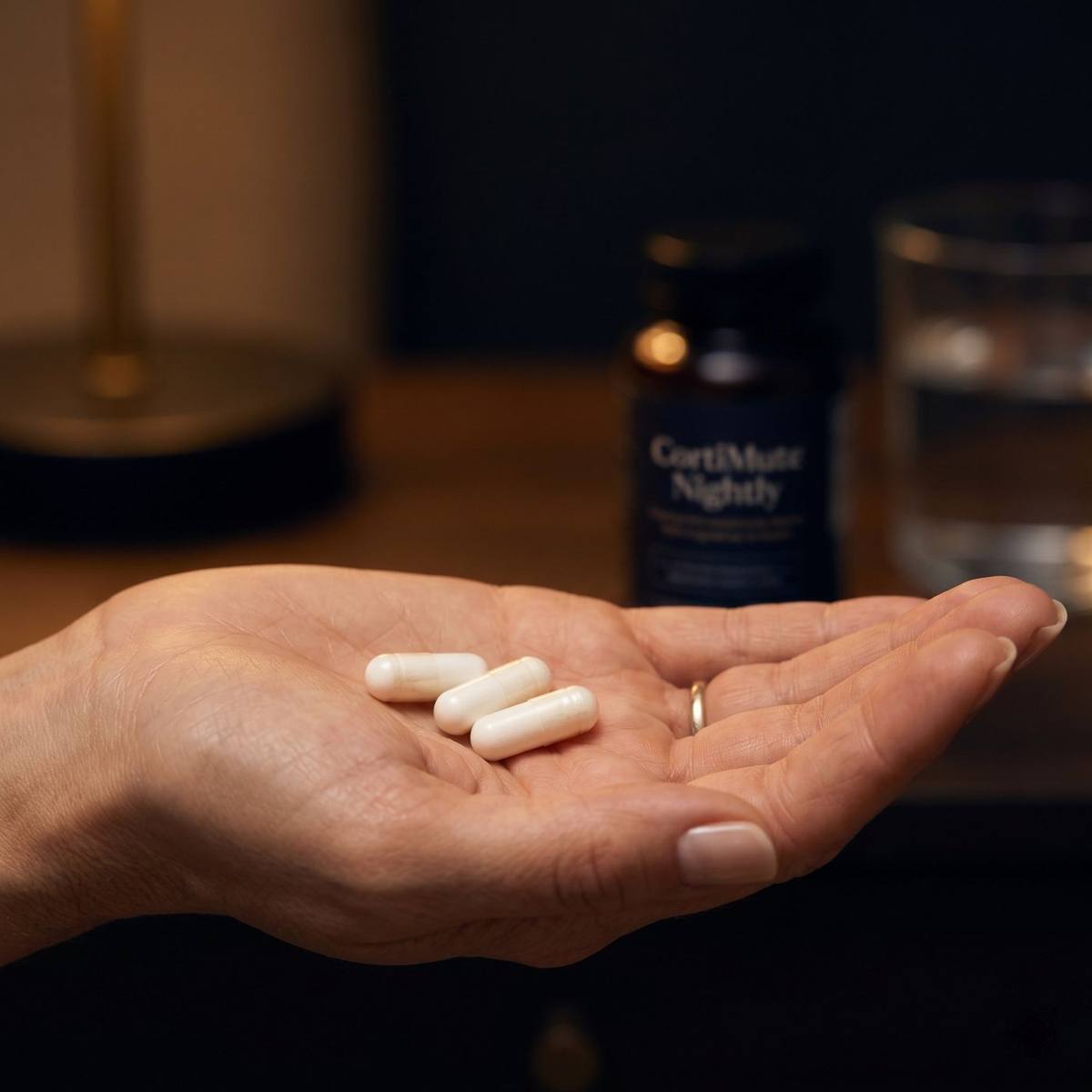
The formula is built. The mechanism is specific. The only question is whether you give it a real trial.
Start My Reset — 60-Day GuaranteeNon-Hormonal · No Subscription · Ships Within 24 Hours

The experiences below are representative of commonly reported results based on product testing and user feedback. Individual results vary. Results are not guaranteed.
"I have been waking up at 3:00 AM for almost three years. My body would be completely empty but my mind just would not stop. I have tried everything — melatonin, herbal blends, GABA supplements. Nothing touched it. Two nights in, I slept through until 5:45 AM. I cried telling my sister. Three weeks later I am still sleeping through. I did not know that was still possible for me."

"I was fully convinced I just had anxiety. My therapist suggested looking into magnesium before going further with treatment. I almost did not try it because I had taken magnesium twice before and it completely wrecked my stomach. This was nothing like that. Zero stomach issues at all. And the wired, frantic feeling at 2 AM that I thought was just who I am now? Gone. I fall asleep and I stay asleep."
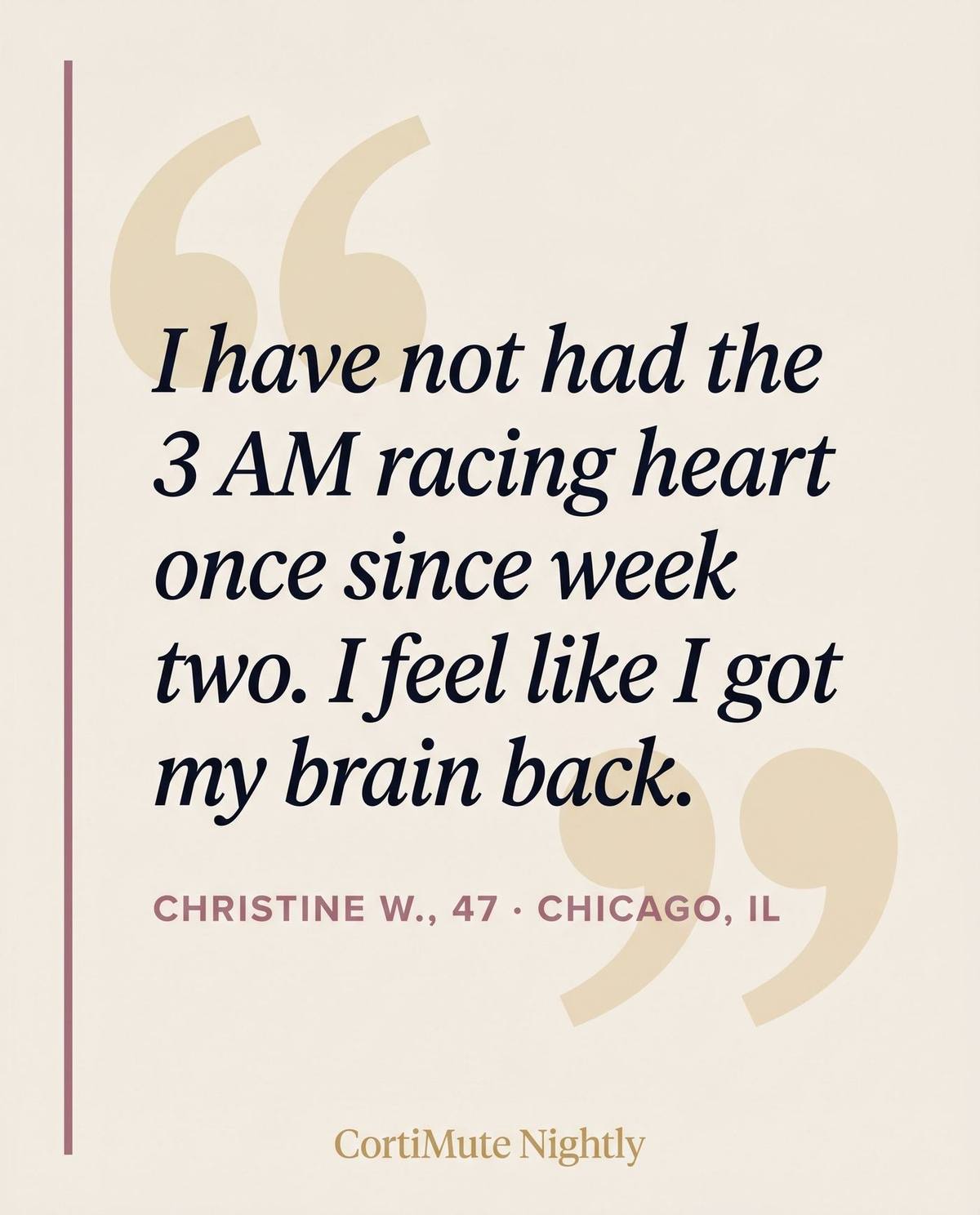
"My husband noticed before I did. He said 'you haven't gotten up in the night in two weeks.' I had stopped counting because I was scared to hope. It has been six weeks now. I have not had the 3 AM racing heart once since week two. I feel like I got my brain back."
"I ordered this with zero expectations. I was ready to return it in two weeks. Three nights in, the tension in my jaw and shoulders started to ease. Week two I was sleeping past 3 AM for the first time in over a year. I immediately ordered three more bottles. I am not someone who writes reviews. I am writing this one."
These aren't outliers. They're what the reset looks like when it has enough time to work.
Start My Reset — 60-Day GuaranteeNon-Hormonal · No Subscription · Ships Within 24 Hours

An honest picture of the timeline. This is where other brands lose your trust by overpromising.
Most women notice jaw tension, shoulder tightness, and leg rigidity beginning to ease. The physical "wired" state is often the fastest to respond. Some see real improvement in sleep within the first week. Most also find that these physical cues — tension easing, the bodily rigidity beginning to lift — become their own nightly reminder to stay consistent.
Daily magnesium build-up allows NMDA blocking and GABA support to hold through the whole night. Most women report the 3:00 AM waking has stopped or become much less frequent.
Many women notice vivid dreams coming back. This is evidence that you are reaching the deep sleep stages you have been missing. Energy, focus, and emotional steadiness typically improve meaningfully here.
Women at this stage describe a shift in their entire daily baseline. Less reactive. Sharper. More stable. Less prone to sudden-onset anxiety. The professional sharpness that felt permanently dulled returns here too — the ability to recall precisely, follow a complex argument, and lead from a position of confidence rather than exhaustion. Three weeks — not one night — is the real benchmark.

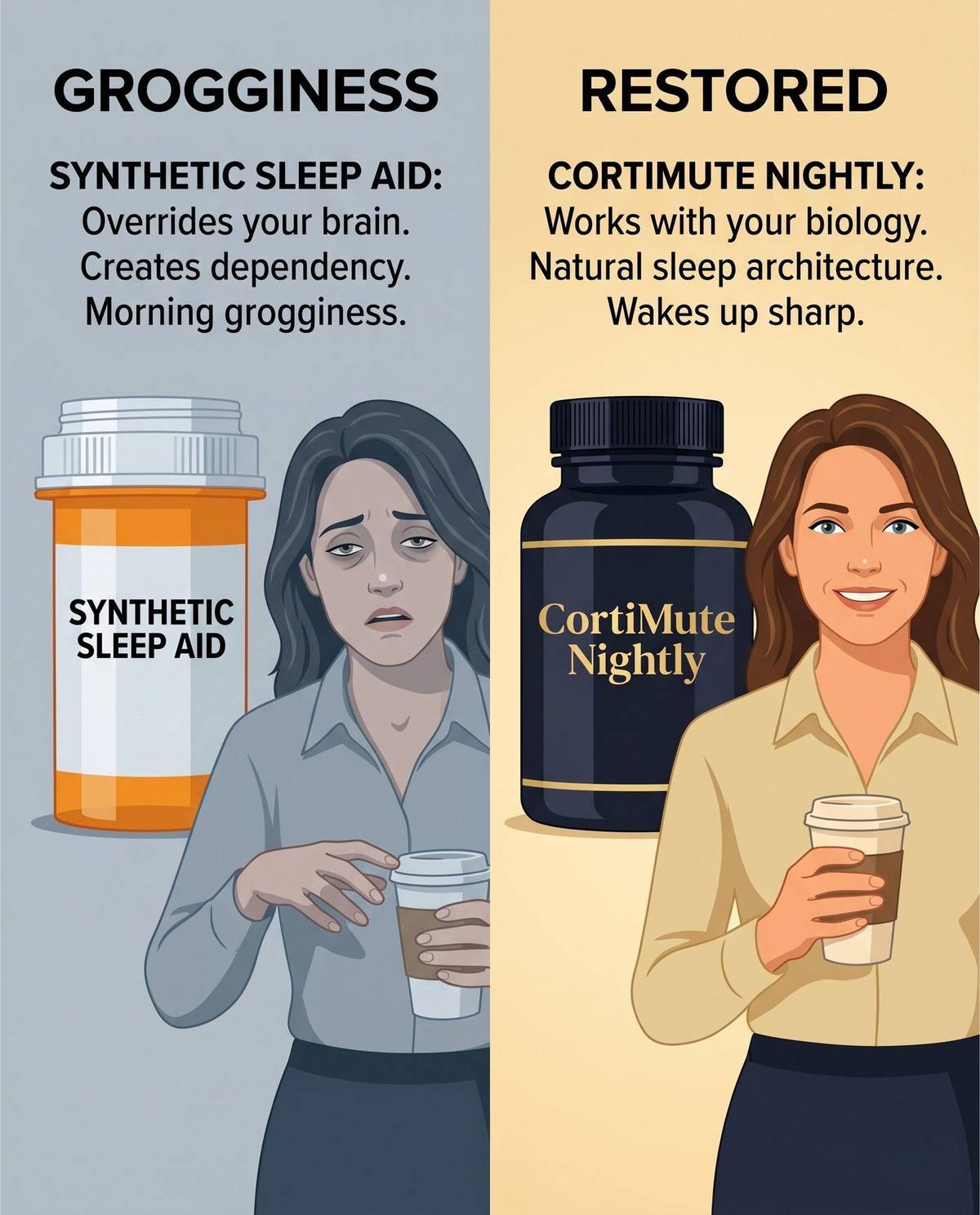
No. Synthetic melatonin forces your body clock into unconsciousness — that's why the morning hangover is real. Prescription sedatives broadly shut brain activity down. Magnesium Bisglycinate does neither. It removes the chemical blockage preventing your own natural sleep from working. Your sleep cycles run normally. Your body completes the stages it needs. Women consistently report feeling sharper in the mornings than they did on melatonin.
Yes. And the two often work better together. CortiMute Nightly contains no estrogen, progesterone, or plant-based hormones. It works on the downstream neurological effects of hormone decline — not the hormones themselves. HRT addresses the hormonal source. CortiMute Nightly addresses the specific brain and nervous system fallout. They target different systems. They are compatible. Always let your doctor know what you are adding to your routine.
Magnesium is a bulky mineral. To hit a meaningful dose without one enormous pill, the serving is split across three smaller veggie caps. The three-capsule format is also what makes the Modular Titration System possible — the ability to split your dose around your day. It is a dosing advantage, not a burden.
Because what's in that bottle isn't the same compound. Most drugstore magnesium sold for sleep is magnesium oxide — a clinical laxative with roughly 4% absorption that doesn't travel to your nervous system. Instead it draws water osmotically into the colon. That's not a side effect. That's the entire mechanism. Magnesium Bisglycinate is chelated at the molecular level, absorbs through specialized amino acid channels, and actually reaches the neurological pathways it's designed to support. The per-night cost difference is less than a coffee. You have likely already paid for the cheap version once. You know how that ended.
Your safety comes first. Some preclinical studies found that glycine at high doses may raise estrogen levels in certain lab models. The meaning of this for women taking normal supplement doses is still being studied. If you have a personal or family history of estrogen-receptor-positive (ER+) breast cancer or any hormone-sensitive condition, please speak with your doctor before starting CortiMute Nightly. We will always put your complete safety ahead of a sale.

I know what is sitting in the back of your mind right now. Because it sat in mine every time I reached for another bottle.
What if this doesn't work for me either?
Here's what I've learned about this industry. The guarantee is where a brand's real intentions live. Not the headline. The fine print.
You have seen the "60-day money-back guarantee" from brands whose fine print quietly says: you must have taken the exact daily dose every single day, avoided alcohol and junk food the whole time, not bought a multi-pack, and returned only a factory-sealed, unopened bottle — within a window so short you may not even discover the terms in time. You may find out on day fifteen that the window closed on day fourteen. You may find out that the bottle you opened and used is the one they won't accept back.
The headline said risk-free. The terms made it uncollectable.
Take the full bottle. Use the full sixty days. If you are not sleeping meaningfully better — fewer 3:00 AM wake-ups, quieter nights, more real rest — contact us for a full refund. No return shipping. No dietary clause. No multi-pack exclusion. No fine print that voids the promise after you've committed.
We want you to use the whole supply before you judge it. Because the reset takes time. We know it works when it gets that time. If it doesn't work for you, you should not pay for it. That is the whole policy.
This formula was built for the perimenopausal context. It is the right choice if:
Not the right choice if you have a personal history of ER+ breast cancer. Please speak with your doctor first.
If you have read this far, you recognize yourself in this.
The 3:14 AM alarm. The exhaustion that never lifts.
The version of you — sharp, present, fully yourself — that you have been trying to get back to.
She is not gone. She is being chemically blocked. And that is fixable.

These statements have not been evaluated by the Food and Drug Administration. This product is not intended to diagnose, treat, cure, or prevent any disease. If you have a personal or family history of estrogen-receptor-positive breast cancer or any hormone-sensitive condition, consult your physician before starting any new supplement. Individual results vary. Timeline descriptions reflect commonly reported experiences and are not guaranteed for every user.